Summary
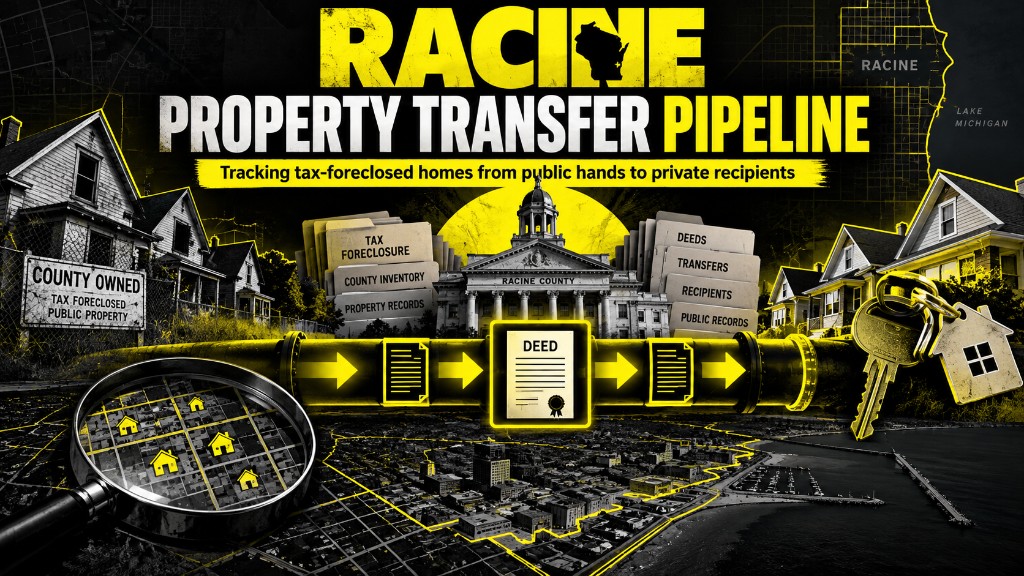
Ten tax-foreclosed Racine homes moved from the County to the City, then to a nonprofit, and ultimately toward private recipients—without the ordinary public-sale process. Emails show City officials involved in coordinating transfers, while the nonprofit’s executive director later wrote that she was “forced” to give certain homes away. H.O.T. Government follows the deeds, the money, and the decisions.
Key findings
ACTIVE INVESTIGATION — PROPERTY & SELECTION RECORDS PENDING
Ten tax-foreclosed homes. A County-to-City-to-nonprofit pipeline. Private transfers, public write-offs, and unanswered questions about who chose the recipients.
Featured question
When public property passes through a government and nonprofit pipeline before reaching private hands, who decides who gets it—and where is the public accountability?
Racine Property Transfer Pipeline examines how ten tax-foreclosed homes moved from Racine County to the City of Racine, then to the Racine Revitalization Partnership (RRP), and finally—at least in seven cases—to private recipients. The investigation is built from recorded deeds, real-estate transfer returns, County resolutions, Common Council records, City memoranda, IRS filings, public-records responses, meeting minutes, court files, and original email chains.
H.O.T. Government’s evidence file stresses that the issue is the public process—competition, price, criteria, notice, proceeds, and disclosure—not an allegation that private purchasers committed crimes.
Central question
Did Racine officials use a lawful municipal-transfer exemption to move tax-foreclosed homes out of public hands without the advertised, appraised public offering that would otherwise apply—and then influence who ultimately received those properties?
How the pipeline worked
- County tax foreclosure — Wisconsin law generally requires tax-deeded property sold to private parties to go through an advertised, appraised public offering. Transfers to municipalities fall under a statutory exemption that became the entry point.
- County to City — Rather than offer the ten homes directly to private buyers, the County transferred them to the City. The City had voted August 20, 2024 to accept and re-transfer the properties nearly seven months before County Resolution 2024-95 was introduced. Seven County-to-City deeds were executed April 9, 2025. The resolution names the Community Development Authority in operative language while the deeds name the City of Racine as grantee.
- City to RRP — The City transferred properties to RRP. Emails show coordination involving City Administrator James Sullivan, Building Department personnel, Neighborhood Enhancement staff, and then-City Development Director Walter Williams.
- RRP to private recipients — Recorded sales ranged from about $10,000 to $45,000, with one gift valued at $10,000. A February 10, 2026 term sheet identified intended recipients before several transfers completed.
The ten homes
According to the County’s own resolution, nine of ten were never offered at sealed bid; the tenth had been offered but received no valid bids. By July 8, 2026, seven had left RRP’s hands. Three remained with RRP: 1001 10th Street, 812 12th Street, and 1309 Grand Avenue. The investigation treats this as one coordinated batch—not ten unrelated dispositions.
Public cost
Resolution 2024-95 attached a fiscal note totaling $600,278.71 in write-offs (tax deeds, special charges, interest, penalties, and other costs). The resolution describes the City’s role as being “to pass through to the Racine Revitalization Partnership.” The evidence file separately identifies an RRP book write-down of approximately $408,663. H.O.T. has located no record showing former owners received proceeds from later private transfers; that does not by itself establish unlawful taking or surplus-equity entitlement without parcel-by-parcel analysis.
County’s stated public purpose
Resolution 2024-95 cites the Towerview neighborhood, rehabilitation, sales to first-time homebuyers, low-to-moderate-income targeting, and housing counseling—the Community Equity Housing Project. The investigative question is whether documented recipient selection and ultimate transfers matched that stated purpose. Language describing the neighborhood as “historically underfunded and redlined” originated in RRP’s September 14, 2023 request and later appeared in government documents.
The email that changed the investigation
On April 30, 2026, RRP Executive Director Kathy Snyder emailed County Supervisor Melissa Kaprelian that RRP had expenses tied to two properties but was “FORCED to give them both away AND pay the title transfer fee.” She described pressure to transfer homes to Tom Buhler and Sherrie Tussler at a loss to RRP. The significance is not that Snyder’s characterization alone proves misconduct—it is that the nonprofit’s leader described outside pressure in writing, making who selected recipients, who applied pressure, and under what authority central questions.
Recipient selection & conflicts
Walter Williams’s February 10, 2026 term sheet listed intended recipients before some transactions. City personnel directed RRP to take calls from certain prospective buyers; other chains show officials tracking transfers. Recorded recipients included Sherrie Tussler (City CDBG Advisory Board), Racine Quality Home Suppliers Corp / Tom Buhler, Christopher and Matthew Zamecnik, Scott Jensen / Premier Services, and JP Concrete LLC. Christopher Zamecnik appears as an RRP board member in IRS filings. H.O.T. does not allege criminal conduct by recipients; it asks whether adequate conflict policies, disclosure, competitive standards, and recusal applied to publicly sourced property.
Dual roles & structural overlaps
Melissa Kaprelian and Renee Kelly concurrently held County Supervisor and City alder roles during key votes. County Treasurer Jeffrey Latus was reportedly listed on RRP’s board in IRS filings during years overlapping foreclosures and RRP’s property request—RRP’s original design also contemplated designated City and County board seats. Open questions include disclosure, recusal, and participation in property discussions.
Repurchase-right question (§ 7-61)
On November 12, 2024—before Resolution 2024-95—the County adopted § 7-61, giving certain former owners of qualifying owner-occupied tax-foreclosed property (or heirs) a right to repurchase before sale, with “sale” defined broadly. H.O.T. has located no record that eligible former owners among the ten were notified before County approval. Legal questions remain on occupancy timing, qualification, notice requirements, and interaction with municipal transfers. The ordinance appears potentially relevant; enforceability requires property-specific legal analysis.
1309 Grand Avenue
Before entering the program, 1309 Grand was owner-occupied; court files document years of delinquency and pandemic-era certified-mail procedures. Unlike most pipeline properties, it had not transferred to a private recipient when the file was updated—it remained with RRP under rehabilitation. City emails referenced a Johnson Financial grant; Snyder corrected the figure to $90,350 from SC Johnson. Open questions include grant source, amount, and why City officials maintained private fundraising details in government email. Ultimate disposition may test whether the program delivers rehabilitation and sale to a qualifying first-time, low-to-moderate-income buyer as the County promised.
Missing safeguard
An August 2024 City briefing memo said City Development would pursue an MOU or agreement with RRP. That document—if it exists—may define restrictions, recipient selection, resale limits, occupancy, affordability, and reporting. If no MOU exists, that raises why properties moved without the safeguard policymakers were told would be pursued.
Key findings (supported by current record)
- A coordinated County → City → RRP → private pipeline existed.
- The municipal-transfer exemption bypassed the ordinary private-sale public offering.
- Nine of ten homes were never offered at sealed bid (per the County resolution).
- Documented public write-offs totaled $600,278.71.
- City officials actively coordinated later dispositions.
- Recipient selection involved government input (term sheet, emails, Snyder’s “forced” account).
- Some recipients held roles connected to public or nonprofit bodies—conflict questions remain.
- Repurchase ordinance § 7-61 predated donation; notification records not yet located.
- Critical safeguards and records—including the promised MOU—remain missing.
What this investigation does not establish
The file does not establish that any private recipient committed a crime, any official accepted a bribe, transfers were criminal, a federal CDBG rule definitely applied, every former owner was entitled to surplus equity or repurchase, every official knew the full history, or the Community Equity Housing Project lacked legitimate public purpose. H.O.T. raises legal and ethical questions from documents; courts and enforcement agencies would determine violations.
Legislative gap
The pipeline illustrates a structural gap: public-sale protections attach primarily at County disposal. Once property moves through the municipal-transfer exemption, protections may not follow when property later moves County → City → nonprofit → private recipient. H.O.T. proposes reforms—tracking formerly tax-deeded property until private ownership, appraisal and write-off disclosure on government transfers, published recipient criteria, conflict disclosures, proceeds tracking, and documented repurchase notice—without prohibiting legitimate affordable housing or nonprofit redevelopment.
H.O.T. Government’s position
The strongest conclusion supported by the current evidence is not that one individual secretly transferred public property—it is that there was a formal pipeline involving multiple layers of government and a nonprofit intermediary, with more than $600,000 in documented write-offs, City coordination of dispositions, low recorded private prices, overlapping organizational roles, and a written claim of forced transfers—while critical selection and safeguard records remain outstanding.
When property taken into public ownership returns to private hands, the public should be able to see who chose the recipient, what the property was worth, what was paid, what rules applied, and whether the original owner received every right the law provided.
Records still needed
- Complete City–RRP MOU or agreement
- Recipient-selection policies and applications
- RRP monthly progress reports
- Full appraisal records
- County § 7-61 notification records
- Former-owner accommodation files
- CDBG Advisory Board attendance and recusals
- RRP board minutes and recusals
- Treasurer correspondence (2023–2025)
- City Development correspondence during the pre-public-action period
- Federal HOME and CDBG funding records
- Grant agreement and permits for 1309 Grand
Right of reply
H.O.T. Government seeks responses from City Administrator James Sullivan, Walter Williams, Daniel Kirchenberg, Kelly Reed, Kathy Snyder, Robert Reinders, Melissa Kaprelian, and the County Treasurer—including directives on recipient selection, legal analysis of the pass-through structure, repurchase and accommodation opportunities for former owners, and actions taken after Snyder’s April 30, 2026 email.
Timeline
-
RRP requests ten foreclosed properties
Racine Revitalization Partnership asks Mayor Cory Mason and County Treasurer Jeffrey Latus for title to ten addresses, free of fees, assessments, and back taxes.
-
Common Council approves City-side transfer
Racine Common Council accepts and agrees to re-transfer the properties via consent-agenda voice voteu2014months before County Resolution 2024-95 is introduced.
-
County adopts repurchase ordinance u00a7 7-61
Racine County creates a local repurchase mechanism for qualifying former owners of certain tax-foreclosed single-family homes.
-
Resolution 2024-95 introduced
County Board introduces resolution authorizing donation of ten homes toward the Community Equity Housing Project; fiscal note documents $600,278.71 in write-offs.
-
County-to-City deeds executed
Seven identified County-to-City deeds are executed and recorded the next day; resolution language names CDA while deeds name the City as grantee.
-
City-to-RRP deeds recorded
City transfers properties to Racine Revitalization Partnership; RRP is also on track for CHDO certification and HOME funds access.
-
Housing meeting
Meeting involving City officials and RRP later becomes central to Executive Director Kathy Snyderu2019s account of pressure over intended recipients.
-
Tussler seeks property access
Sherrie Tussler, a City CDBG Advisory Board member, seeks access to several RRP properties; Snyder initially declines to negotiate.
-
Term sheet lists intended recipients
City Development Director Walter Williams circulates a term sheet identifying intended private recipients before several transfers complete.
-
1212 Highland Avenue gifted to Tussler
Property transfers to Sherrie Tussler as a gift valued at $10,000u2014raising federal conflict-of-interest questions pending funding nexus review.
-
1013 12th Street to Tom Buhler entity
Racine Quality Home Suppliers Corp / Tom Buhler acquires property for approximately $10,000.
-
Snyder email to County Supervisor
RRP Executive Director writes she was u201cFORCED to give them both away AND pay the title transfer fee,u201d describing pressure over specific recipients.
-
Four additional private transfers
Properties move to Christopher and Matthew Zamecnik, Scott Jensen / Premier Services, and others; Christopher Zamecnik is an RRP board member per IRS filings.
-
610 11th Street to JP Concrete LLC
Sale for $35,000; seven of ten homes have now left RRP. Three remain with RRP including 1309 Grand Avenue.
-
1309 Grand still in rehabilitation
1309 Grand Avenue remains with RRP under active rehab; open questions on grant source (Johnson Financial vs. SC Johnson) and ultimate qualifying sale.
-
Investigation published
Ten tax-foreclosed Racine homes moved from the County to the City, then to a nonprofit, and ultimately toward private recipients—without the ordinary public-sale process. Emails show City officials involved in coordinating transfers, while the nonprofit’s executive director later wrote that she was “forced” to give certain homes away. H.O.T. Government follows the deeds, the money, and the decisions.
-
Case file updated
Case details revised. Evidence library lists 4 case files.
Evidence library (4)
Case files
Sources & references
- Racine County u2014 Official website
- City of Racine u2014 Official website
- Wisconsin Register of Deeds (property records)
- Investigation video u2014 Part 1 (YouTube)
- Investigation video u2014 Part 2 (YouTube)
- Investigation video u2014 Part 3 (YouTube)
- Investigation video u2014 Part 4 (YouTube)
- Wisconsin Statutes u00a7 19.37 u2014 Public records enforcement
Right of Reply / Response Request
- Contacted
- James Sullivan; Walter Williams; Daniel Kirchenberg; Kelly Reed; Kathy Snyder; Robert Reinders; Melissa Kaprelian; Racine County Treasurer Jeffrey Latus; Racine County Board; Racine Common Council; Racine Revitalization Partnership
- Date contacted
- 2026-10-01
Priority records: Cityu2013RRP MOU or agreement; recipient-selection policies; RRP progress reports; appraisals; u00a7 7-61 notification records; CDBG board recusals; RRP board minutes; HOME/CDBG funding nexus.nnH.O.T. stresses accountability for processu2014competition, price, criteria, notice, proceeds, and disclosureu2014not an allegation that private purchasers committed crimes. Every named person is presumed innocent.
Share this
Support the Work
Your support helps fund public records, legal research, reporting, events and citizen education.